

If you’re operating in a working environment with flammable gases, vapours, or combustible dust, an uncertified or mismatched motor can become an ignition source with disastrous consequences. ATEX motors are certified explosion-proof motors that are engineered to work safely in these types of high-risk areas and reduce the risk of explosions. At Beta Power Engineering, we specialise in industrial motors and supply high-quality, certified units for gas and dust-risk areas under ATEX classification. This guide covers ATEX, its zone classifications, and the features of ATEX-certified motors, along with parameters to review when selecting the most appropriate option.

What is ATEX?
ATEX certification is a method that classifies hazardous settings into zones based on their degree of danger and specifies the type of protective gear required in each zone. When flammable gas, vapour, mist, or dust concentrations in the air are within ignition limits, there is a risk of an explosion if they come into contact with an ignition source. This is classified as a hazardous zone. Typical examples include petrochemical, paint, flour, chemical, fuel, and pharmaceutical plants. The first line of defence against an explosion is to classify the electric motors used in these zones properly.
ATEX Zone Classification
Zone classification is determined by the amount of time and how frequently an explosive atmosphere occurs. An area that is constantly exposed to a potentially explosive atmosphere needs a higher degree of protection compared to an area that is only at risk if there is a fault. The zones are separated into three groups, with zones denoted in each group in descending order.
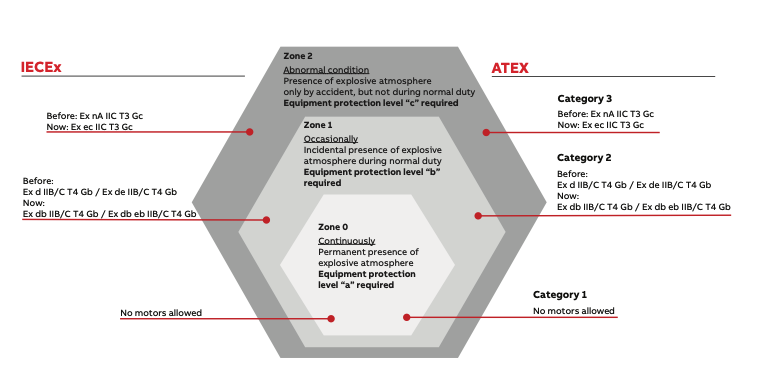
Gas Zones and Groups
The gas group affects the required level of protection. Industrial gases are classified into Group IIA, IIB and IIC according to their ignition characteristics and the energy required to ignite them. IIA includes gases such as propane, while IIB covers more easily ignited gases and IIC represents the most demanding group, including hydrogen and acetylene. As ignition risk increases, so does the required level of protection.
Hazardous areas are classified into three gas zones based on the incremental risk of an explosive atmosphere arising. Zone 0 is the highest-risk classification, where the environment is constantly exposed to explosive gases, such as inside tanks and enclosed process vessels. Electric motors are generally positioned outside these areas wherever practical.
Zone 1 covers locations where an explosive atmosphere may occur during normal operation, such as around pump stations, filling lines and process equipment. This is a common classification for industrial motor applications, so choosing suitable explosion protection is particularly important.
In Zone 2, an explosive atmosphere is only expected under abnormal or fault conditions and for a short period. Although the risk is lower and more economical protection may be suitable, a standard motor is still not appropriate.
Correctly matching certification to both the hazardous zone and the gas group classifications is imperative to keep operations and workers safe in high-risk areas.
Dust Zones and Dust Groups
Combustible dust can create an explosion risk as serious as flammable gases. Materials such as flour, starch, sugar, coal and metal dust can form an explosive atmosphere when dispersed in the air at the right concentration. Dusts are classified into Groups IIIA, IIIB and IIIC, according to their characteristics. These include combustible fibres and flyings, non-conductive dusts and conductive dusts. Conductive metal dusts are particularly demanding, as they can present both ignition and electrical risks.
As with gases, hazardous dust environments are classified into Zones 20, 21 and 22, based on how frequently and for how long an explosive dust atmosphere is expected to be present. Zone 20 represents the highest risk, where combustible dust is present in the environment continuously or for long periods, while Zones 21 and 22 cover situations where it is present occasionally or only briefly under abnormal conditions.
Dust buildup can insulate a motor unit and trap heat, so when you choose a motor for a dust-laden hazardous area, take into account the potential for dust accumulation and its effect on motor temperature.
Temperature Classes T1 to T6
Temperature classes establish the maximum surface temperature a motor can reach while operating. The motor must stay below the auto-ignition temperature of flammable gas in the air.
These classes range from T1 to T6. T1 allows the highest surface temperature, while T6 has the lowest. The required temperature class depends on the substance present in the hazardous area: the lower its auto-ignition temperature, the lower the motor’s permitted surface temperature and the stricter the required temperature class. Selecting the correct temperature class is an important part of guaranteeing an ATEX motor is suitable for its operating environment.
How to Approach ATEX Motor Selection
Correct motor selection goes beyond determining the required kW rating and motor speed. When choosing an ATEX motor, you should consider the following parameters: the hazardous zone and Equipment Protection Level (EPL), the gas or dust group and required temperature class, the motor’s power and speed, the appropriate IP rating, and the enclosure and cooling method.
The motor must match the classified hazardous area and the substances present, and provide sufficient power for the driven equipment. Environmental conditions will determine the required ingress protection, and the cooling method should reflect the application, particularly where variable-speed operation or a VFD is involved.
What Are the Specifications of ATEX Motors?
ATEX motors have construction and protection features intended to prevent the motor from becoming an ignition source. They must have a suitable ingress protection rating to protect the motor against dust and moisture entering the enclosure. These motors typically feature cast iron or steel housings which can withstand hazardous industrial environments.
ATEX motors come in a range of power ratings and speeds, from relatively small motors to units of 500 kW and beyond. Many units also incorporate PTC thermistors or other embedded temperature sensors to monitor winding temperatures. With suitable protection equipment, these are able to prevent overheating and provide additional operational protection.
What Are the Specifications of ATEX Motors?
Ex d (Flameproof)
motors use a strong enclosure to contain an internal explosion and prevent escaping gases from igniting the surrounding atmosphere. They are used in Zone 1 and Zone 2 gas applications and can be specified for gas groups IIA, IIB or IIC.
Ex e (Increased Safety)
motors are designed to prevent sparks, arcs and excessive temperatures under normal and foreseeable abnormal conditions. They are commonly used in Zone 1 and Zone 2 applications such as fans and pumps, with particular attention required to the motor’s tE time under stalled-rotor conditions.
Ex n (Non-Sparking)
motors are intended primarily for Zone 2 applications, where an explosive atmosphere is only expected under abnormal conditions and are usually more economical than Ex d or Ex e protection.
Ex t (Dust Protection)
uses a sealed enclosure to prevent dust ingress and control the motor’s maximum surface temperature. The required level of ingress protection and temperature rating depends on the dust zone and the characteristics of the material present.
Ex p (Pressurised Enclosure)
motors employ a continuous supply of clean air to maintain positive pressure inside the motor enclosure so that hazardous gases do not enter the unit. This approach is useful for large or high-voltage motors where a flameproof enclosure would be impractical.
Hazardous-Area Motors From Beta Power
At Beta Power Engineering, we supply a range of ABB hazardous-area motors, with solutions designed for different ATEX zones and operating environments. As an ABB Authorised Value Provider, we provide the technical expertise needed to specify the right hazardous-area motor for the application.
The range includes flameproof, non-sparking and dust ignition-proof motors, covering both gas and dust hazardous areas. Flameproof motors are available for Zone 1 applications, with Ex d and Ex de protection and outputs from 0.55 to 950 kW. Non-sparking motors cover Zone 2 applications, with outputs from 0.25 to 355 kW, while dust ignition-proof motors are available for Zones 21 and 22, with outputs extending from 0.25 up to 2,000 kW.
Our ABB motors are available in a broad range of IEC frame sizes, pole configurations and voltage options, with protection ratings including IP55 and, depending on the motor type, options up to IP66. The hazardous-area range is ATEX and IECEx-certified, with products also available with other national certifications where required.
Trust Our Experts
If you need an ATEX-certified motor for a new installation or replacement application, contact our team at Beta Power to discuss your requirements and find the right ABB ATEX motor for your environment.
